

Fascia therapy
What is fascia?
![[Cross-section of the subcutis]](hypodermis-en.gif "Cross-section of subcutis")
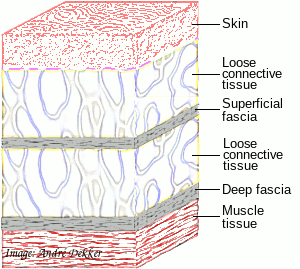
The fascia is the connective tissue that surrounds and connects every muscle and organ, forming continuity throughout the body. The fascia around individual muscles is also known as muscle sheaths. The adjacent picture shows a simplified cross-section of the subcutaneous tissue of the body. From top to bottom you see:
- the skin;
- a layer of loose connective tissue;
- the superficial fascia;
- a layer of loose connective tissue;
- the deep fascia;
- muscle tissue.
Formerly, the fascia was thought to be just a kind of packing material. Therefore, most anatomy textbooks only depict the fascia in a very limited way. But in recent years, it has been discovered that the fascia performs many indispensable functions in the body. The fascia is an organ in itself. The fascia plays an important role in the power transmission of muscles. Much of the body’s metabolism and fluid transport passes through the fascia. The fascia contains blood and lymph vessels and is particularly rich in nerves. All external forces acting on the body and all forces produced by the muscles cause tension in the fascia, which propagates from one place to another over certain long ‘lines of pull’. The free nerve endings in the fascia perceive this tension and allow the contractions of different muscles to be aligned. The nerve endings in the fascia also provide the brain with information about the state of the adjacent tissue. When the fascia does not function properly, it interferes with the functioning of the whole body.
The composition of the fascia
The fascia consists of several layers or membranes. Each membrane consists of collagen and elastin fibres and fluid. The ratio between the different kinds of fibres and also the amount and composition of the fluid determine the mechanical properties of the fascia. Some membranes are as sturdy as cotton fabric, but others are as fine as a spider’s web. The membranes are connected by a network of elastin and collagen fibres aka loose connective tissue, which allows movement between the membranes within certain limits. This network includes fat cells, interstitial fluid, blood and lymph vessels and nerves. The same vessels and nerves also run through the membranes of the fascia. When this system functions normally, all structures within it can glide past each other without friction. This allows the body to move smoothly and without pain.
The treatment of the fascia
The more that has become known about the functioning of the fascia, the more gentle the treatment methods have become. Initially, one tried to stretch the fibres in the fascia with a lot of force. But according to recent research, movement restrictions in the fascia and entrapment of nerves are usually caused by ‘drying out’ of the fascia or a change in the composition of the fluid. Gentle techniques aimed at stimulating fluid transport in the fascia are often more successful than forced stretching and more comfortable for the client.
Because the fascia and muscles are in close contact with each other, it is impossible to treat them separately. The difference between classical and fascial massage lies mainly in the depth of the massage. Classical massage treats muscles through the fascia, while fascial massage stays more on the surface of the muscles. This does not mean that fascial massage always stays right under the skin. Some of the fascia lies deeper than where most classical massage therapists have learned to treat.
In my experience, ‘inviting’ tissues to change leads to more lasting treatment results than forcing change. This is why I have abandoned all ‘aggressive’ and painful treatment methods. Nowadays, I mainly use techniques that I learned from
- Structural Integration, also known as Rolfing®,
- Kalevala bonesetting,
- classical osteopathy, and
- craniosacral therapy.
![[Treatment of the lateral raphe]](lat-raphe.jpg "Lateral raphe")
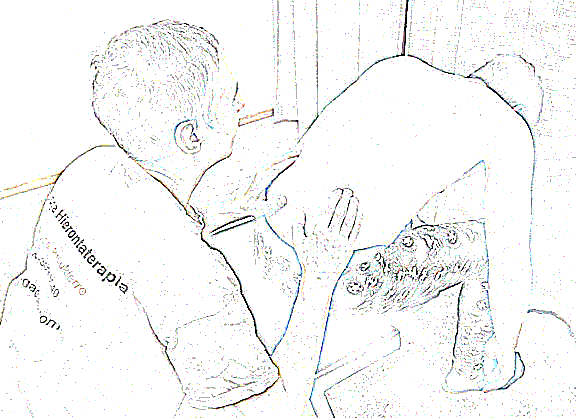
All four treatment methods have their own place. Structural Integration primarily uses powerful massage techniques to stretch ‘shortened’ fascia and promote the sliding of fascial layers. Kalevala bone setting focuses on improving the mobility of the fluids in the fascia. Classical osteopathy achieves results through precise touch rather than force. Craniosacral therapy makes it possible to treat fascia that cannot be touched or cannot be touched safely, such as in the skull, chest, spinal canal, or deep in the pelvis.
After the fascia therapy
All treatments of the fascia, no matter how gentle, can cause pain in the two days following the therapy. Heavy physical exercise or fluid loss too soon after the treatment can negate the results. If possible, rest after the treatment and avoid major physical exertion during the first two days after the treatment. I think it is okay to go to the sauna, as long as the temperature stays low enough for you to breathe freely, you drink lots of water, and avoid alcoholic drinks. But it is best to hold off on sunbathing.