

Therapies
Painless treatment
Treatment should not hurt. If you feel pain, your body and mind will resist the treatment. Only when you feel completely safe can I achieve good treatment results. If I do something that causes pain or if, for example, a certain position on the treatment table is uncomfortable, I hope you will let me know immediately. I will then modify the treatment to avoid the pain. Moreover, the pain you feel is a piece of the puzzle that tells me what lies behind your symptoms.
Choosing the right therapy
![[Sensitive fingers]](sensitive-fingers.gif "Sensitive fingers")
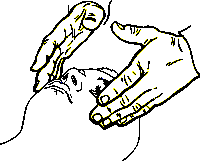
The aim of a treatment is to improve the functioning of your body. To achieve this goal, I have many treatment methods at my disposal. Rarely do I know in advance which therapy I will use to treat a client, nor does the client herself/himself know which treatment method is most suitable for her/him. I usually let my hands decide. During a treatment session, I may switch from one therapy to another several times. Below are brief descriptions of the treatment methods I have learned and links to more information.
Massage
![[Mobilizing massage of the arm]](wrist-extension.jpg "Mobilizing massage")
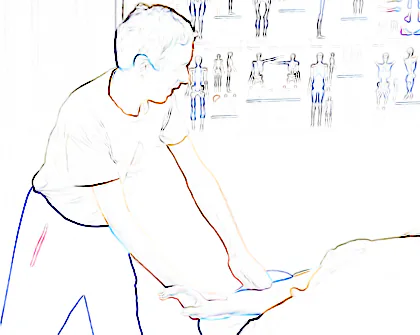
Massage is characterized by rhythmic movements of the masseur’s hands, or of another ‘tool’ that he or she uses, over the client’s skin. The aim of massage is to improve the functioning of the soft tissues. I almost always combine massage with movement of the body part being massaged. This is called mobilizing massage. My massage is far from mechanical. I constantly observe what is happening under my hands and try to respond in the best possible way.
Mobilization treatment
![[Mobilization of foot joints]](foot-mobilisation.jpg "Mobilization of foot joints")
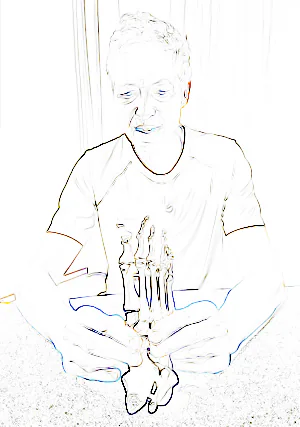
Mobilization means improving the mobility of joints or soft tissues. Mobilization does not involve cracking or forcing anything. I only make movements that the body can follow voluntarily.
Soft tissues are often stuck due to adhesions. Also, when a joint is stuck, this often originates in the soft tissue. Possible causes are adhesions in the joint capsule or contraction of ligaments. The tension in ligaments is controlled by nerves, which is why ligaments can respond to problems both inside and outside the joint. The SI joints are a good example of this. Many a time, I don't need to mobilize a blocked SI joint at all, but it opens up on its own when I treat another place in the body.
My first introduction to mobilization techniques was in the “Kalevala bonesetting” training course. Since then, I have learned more precise mobilization techniques in other advanced training courses. I feel that I am now a bonesetter in the true sense of the word, even though I no longer belong to the Kalevala bonesetters.
Triggerpoint therapy
![[Trapezius trigger points, Travell & Simons Vol. 1 Figure 6.2]](travell_bd1_fig6.2.gif "Trapezius trigger points") ‘Travell & Simons’, Volume 1, Figure 6.2.
‘Travell & Simons’, Volume 1, Figure 6.2. A trigger point is a pressure-sensitive spot in a muscle that radiates pain to a location outside the trigger point. My own trigger points sparked my interest in massage and other manual treatments. I used to think that trigger points were the cause of my own symptoms and those of my clients, but now I see things differently. Trigger points are themselves a symptom. Trigger point therapy is an effective way to quickly relieve pain and reduce muscle tension, but more is usually needed for a lasting effect. For more information, see my page on trigger points.
Fascia therapy
Classic massage primarily targets the muscles. Fascia therapy focuses more on the fascia surrounding the muscles. This fascia forms a continuous network throughout your entire body. The effect of treatment therefore extends far beyond the treated area. For more information, see my page on fascia therapy.
Scar treatment
The visible scar on the skin is just the tip of the iceberg. Most of the scar tissue is located beneath the skin and often extends far beyond the area of the visible scar. A scar can disrupt the body's balance even at a great distance. For more information, see my page on scar tissue massage.
Craniosacral therapy
Craniosacral therapy is a special form of connective tissue therapy or fascial therapy. It induces deep relaxation throughout the entire nervous system. It often reveals hidden causes of symptoms, both physical and emotional. It relaxes the jaw muscles and the effect is usually long-lasting. The treatment is carried out through clothing, and you will lie on your back, if this position is comfortable for you. For more information, please visit the Upledger Institute’s website and watch this YouTube video. English subtitles are available for this video, as well as machine translations into other languages.
Visceral Manipulation
All internal organs must be able to glide without friction in relation to one another and to the connective tissue membranes of the musculoskeletal system. When the mobility of an organ is impaired, not only is the functioning of the organ itself adversely affected, but the musculoskeletal system must also adapt. This can, for example, cause stiffness and pain in the pelvis, the spine, the chest, joints and limbs, and may even affect blood circulation. Visceral manipulation involves gentle manual techniques designed to restore the normal mobility of organs. For more information, please see the Barral Institute’s webpage on visceral therapy.
When should you not come for treatment?
Please stay at home if you have
- a fever;
- a cold or any other illness that is highly contagious;
- an acute flare-up of an inflammatory disease.
Treatment is not recommended
- during the first two days of your period (effectiveness is reduced);
- within two days of having a vaccination (may increase side effects).